Manual WhatsApp works until it does not
Most Indian SMEs start on the free WhatsApp Business app: owner replies from one phone, saves contacts, maybe uses quick replies. Cost is near zero and customers love the personal touch. ROI is positive while volume is dozens of conversations per day, not thousands.
The breaking point arrives with Meta Lead Ads, ecommerce order volume, appointment no-shows, or an agency managing five clients each expecting instant follow-up. Manual copy-paste cannot hit a five-minute SLA for hundreds of daily leads. Missed messages become lost revenue — especially during festival peaks when staff is on the shop floor.
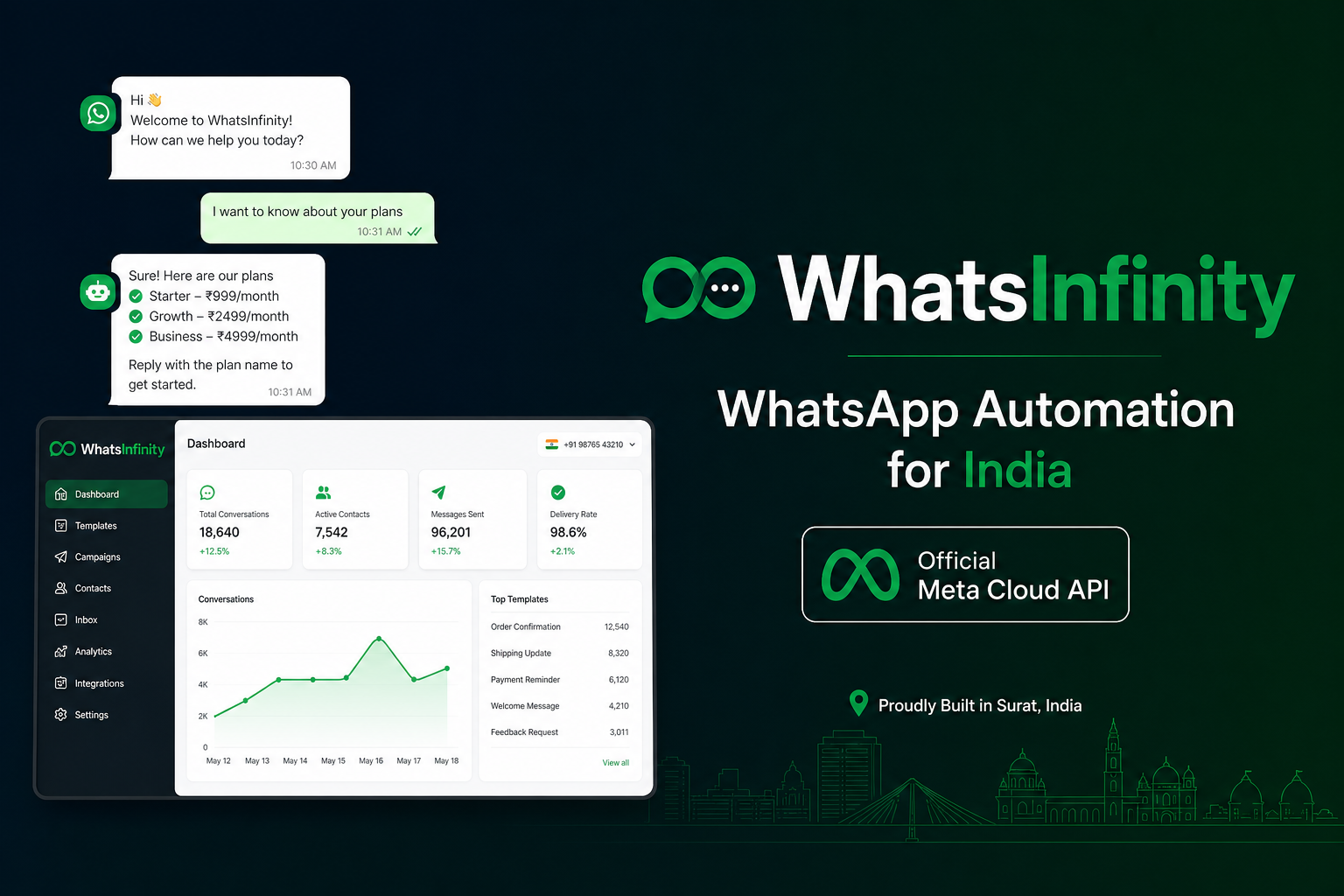
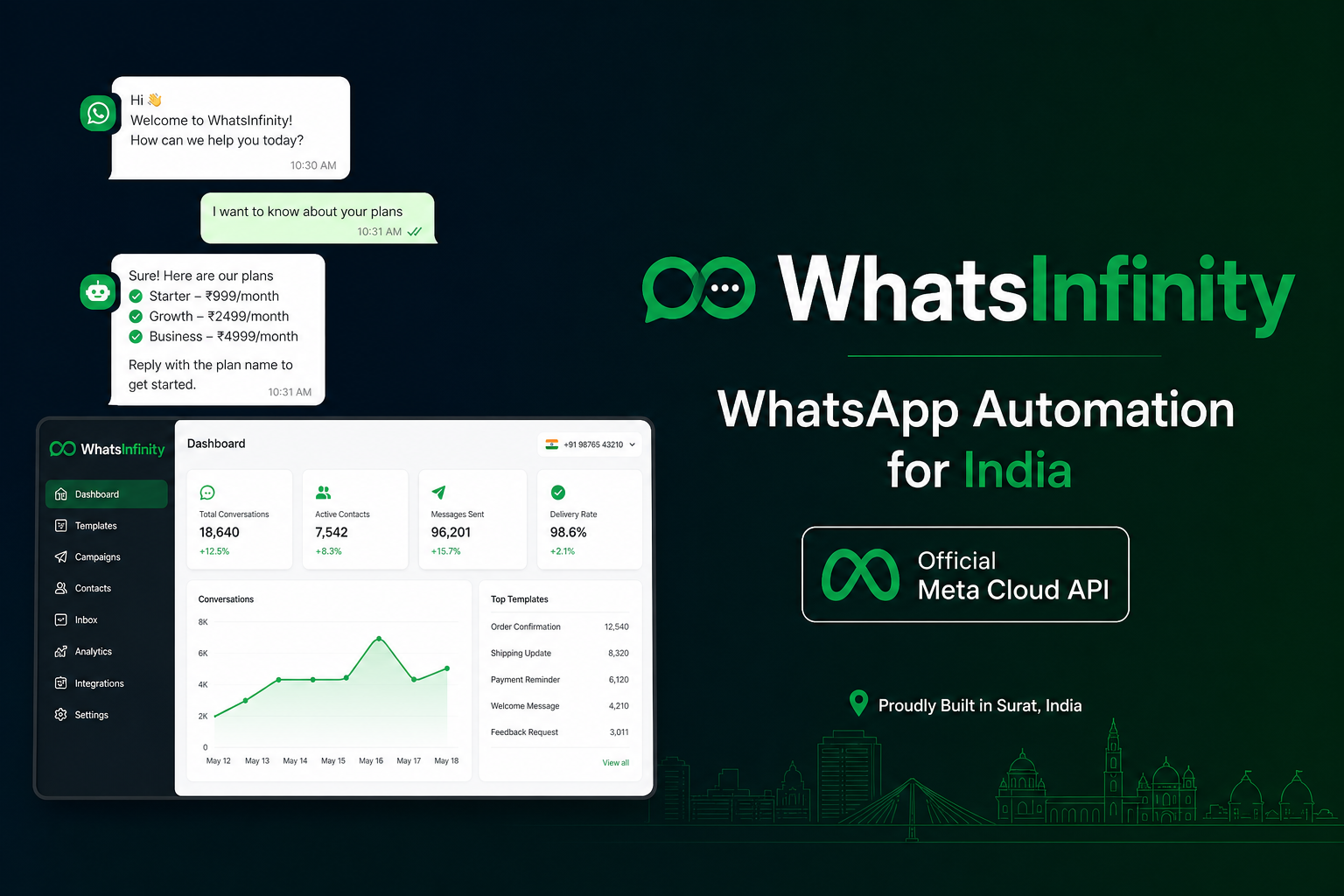
Automation via Cloud API does not remove the human element for closing deals; it removes repetitive template-worthy touches: welcome, reminder, payment link, delivery update. WhatsInfinity implements that layer with flows and broadcasts while your team handles replies in WhatsApp as today.
Defining automation in the WhatsInfinity context
Automation here means Meta-approved template messages triggered by rules you configure: customer assigned to flow, step delays elapse, business hours allow send, variables resolve from customer record. It is not a generic drag-and-drop chatbot builder with AI intents — inbound keyword routing is out of scope by design.
Templates sync from Meta; broadcasts fire to segments; flows drip over days. Queues backed by Redis retry failed jobs and alert after three failures. Analytics show delivery and read rates so ROI discussion uses data, not gut feel.
Agencies multiply automation value: one operations playbook cloned across client tenants beats hiring dedicated WhatsApp operators per SMB.
Cost comparison: hidden manual labour
Manual messaging costs salary time. If a staff member spends three hours daily sending reminders at ₹15,000/month fully loaded, that is ₹180,000/year before attrition and training. Peak seasons require overtime or missed sends.
WhatsInfinity pricing sits at client plan level with limits on customers, flows, and monthly messages — predictable compared to linear headcount growth. Agencies bundle automation into retainer fees, improving margin versus hiring junior executives to paste templates.
Cloud API conversation charges from Meta apply separately; budget those per Meta's pricing for your template categories and country. Manual app usage has no per-message fee but cannot legally scale promotional outreach.
- Manual: low direct cost, high hidden labour, poor scalability
- Automation: platform + Meta fees, low marginal cost per additional message
- Break-even often appears between 50–200 outbound touches per day depending on wages
- Agencies amortize setup across many clients for faster ROI
Speed-to-lead ROI
Studies across industries show conversion drops when leads wait hours for a response. Manual teams during lunch breaks or deliveries routinely miss the golden fifteen-minute window. An automated flow step with zero delay sends a welcome template the moment a customer is imported from Lead Ads or CSV.
Measure ROI as incremental conversions times average order value minus automation cost. Example: twenty extra orders/month at ₹2,000 AOV = ₹40,000 revenue; if automation costs ₹5,000 all-in, payback is obvious. Without tracking, founders underestimate manual drop-off.
WhatsInfinity execution logs show which flow step failed — variable missing, template rejected — so you fix leaks instead of blaming ad quality.
Consistency and error reduction
Humans typo phone numbers, forget festival pricing, or send the wrong PDF. Automation maps variables from structured fields — name, order id, tracking link — reducing embarrassment in bulk. CSV duplicate rejection forces clean data once rather than repeated manual mistakes.
Business hours in flows stop midnight sends that manual night-shift might trigger when clearing backlog. Brand voice stays consistent when templates are pre-approved by marketing rather than improvised by interns.
When exceptions occur, humans intervene on individual chats; automation handles the eighty percent that is repetitive.
Broadcast ROI vs one-by-one forwards
Forwarding a promotion manually to two hundred chats violates UX norms and cannot track delivery. A template broadcast to two thousand opted-in customers completes in the background with read rate reporting. Campaign ROI becomes attributable: sent 2,000, read 1,200, orders 80, revenue ₹160,000.
Segment tags improve ROI further — VIP customers get early access template; general list gets next-day template. Manual segmentation at scale is error-prone; tag-based selection in WhatsInfinity is repeatable.
Festivals amplify returns: one well-timed broadcast beats weeks of individual follow-ups if the list opted in for offers.
Compliance ROI: avoiding bans and fines
Manual bulk forwards from unofficial tools risk number bans — losing WhatsApp means losing a primary sales channel overnight. Policy-compliant Cloud API sends through approved templates with opt-in records reduce that existential risk.
TRAI-aware marketers treat consent seriously; documented opt-in and opt-out handling avoids complaints that manual lists cannot prove. Failed message logs demonstrate due diligence if a customer disputes contact.
ROI of compliance is negative cost avoided: re-acquiring customers after a ban, legal fees, or brand reputation damage exceeds automation subscription cost for most SMEs.
When manual still wins
High-touch sales — luxury real estate, custom jewellery, complex B2B — need human negotiation. Automation should warm and qualify, not close. Very low volume hobby businesses may not justify setup time.
If your entire pipeline is inbound chat with no outbound marketing, the Business app may suffice until you add Lead Ads or order notifications at scale. WhatsInfinity adds most value when outbound template volume or multi-step nurture appears.
Inbound replies are still manual via WhatsApp on phone — plan staffing for conversations automation starts.
Agency ROI model
Agencies reselling WhatsInfinity charge clients setup plus monthly management. Standard flows (welcome, abandoned cart reminder analog via custom fields, festival broadcast) deploy once per vertical and clone. Impersonation speeds support without password sharing.
Multi-tenant isolation means one agency dashboard oversees delivery analytics for all clients — proactive fixes before clients notice drops. Plan expiry handling pauses automation immediately, prompting renewal conversations tied to revenue.
ROI for the agency is margin on retainer minus platform cost; ROI for the client is conversion lift and labour saved — both should appear in QBR slides with WhatsInfinity export data.
Simple ROI worksheet
List monthly manual hours on repetitive WhatsApp tasks, multiply by loaded hourly cost. Add estimated lost leads from slow response times times conversion rate times AOV. Sum as manual burden.
Subtract WhatsInfinity plan, Meta message fees, and one-time setup hours. If automation burden is lower and revenue lift positive within three months, migrate. Start with one flow and one broadcast, measure read and conversion rates for two cycles, then expand.
Indian SMEs that treat WhatsApp as a revenue channel — not a cost centre — consistently find automation ROI exceeds manual past modest scale. The question is timing, not whether.
Frequently asked questions
- At what volume should an Indian SME switch from manual to automation?
- Many teams switch when daily outbound touches exceed roughly fifty to one hundred, or when Lead Ads make sub-fifteen-minute follow-up impossible manually. Festival campaigns to large opted-in lists are another trigger.
- Does WhatsInfinity replace my WhatsApp Business app?
- No. Customers use WhatsApp normally. Your team uses WhatsInfinity for template flows and broadcasts; conversational replies typically stay on the business phone app.
- How do I prove ROI to my client or CFO?
- Use delivery and read analytics plus downstream metrics — orders, appointments, payments — attributed to campaigns. Compare labour hours before and after automation for cost savings.
- Is automation risky compared to manual sending?
- Policy-compliant automation through approved templates and opt-in lists is lower risk than unofficial bulk tools or manual spam. Poor list hygiene or unapproved copy is risky in either model — automation just makes scale auditable.