
In this guide · 8 sections
The short version
Meta has billed the WhatsApp Business Platform per delivered message, not per conversation, since 1 July 2025. On 1 October 2026 two things that used to be free started costing money: service messages (your free-form replies inside the 24-hour customer service window) beyond 1,000 a month per phone number, and utility templates sent inside an open customer service window.
For most Indian SMBs the bill change is small. For high-volume support teams that send many order updates while chats are open, it is noticeable. This guide explains what changed, what is still free, and how to keep costs in check.
What changed on 1 October 2026
- Service messages are billable again after the first 1,000 per business phone number per month. They had been free since 1 November 2024. Unused free messages do not roll over.
- Utility templates sent inside an open customer service window are now charged at the regular utility rate. They had been free since 1 July 2025.
- Meta asked solution providers and directly integrated businesses to have a payment method on file by 30 September 2026, or service message delivery could stop.
- Meta updated rate cards for several markets and expanded authentication-international rates to more countries.
What is still free
- Messages customers send you are never charged.
- The first 1,000 service messages per phone number each month.
- Messages in a free entry point window: when a customer messages you from a Click-to-WhatsApp ad and you reply within 24 hours, Meta’s documentation says the window can stay open for up to 7 days, and messages in it are free.
- Eligible government and non-profit organisations keep free service messages beyond the monthly allowance until 31 December 2027, per Meta.
Indian rates at a glance
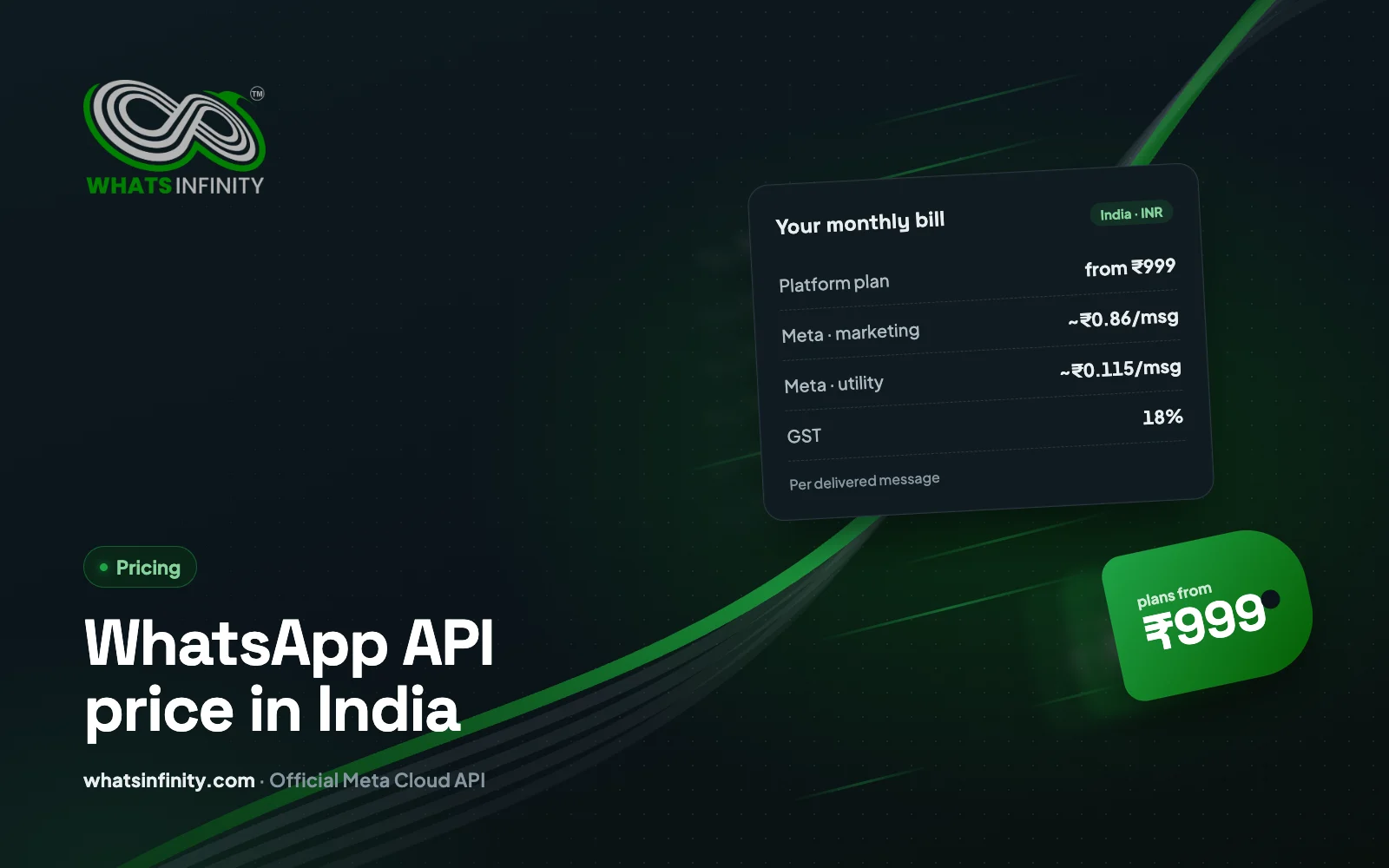
Meta publishes India as its own market on the rate card. Third-party trackers of the July 2026 card list roughly ₹0.86 per marketing message, roughly ₹0.115 per utility or authentication message, and roughly ₹0.115 per service message beyond the free 1,000 to +91 numbers, with a higher authentication-international rate when a business registered outside India sends OTPs to Indian users. Add 18% GST. Utility and authentication get volume discounts only at very high volumes; marketing has no volume tiers.
Meta also launched INR billing for eligible Indian businesses on 1 January 2026, and says eligible accounts must move to INR billing by 31 December 2026. If your provider still bills Meta fees in USD, ask about their migration plan.
A worked example for a D2C brand
Take a brand that sends 20,000 marketing messages, 15,000 utility updates (half of them while a chat is open) and 3,000 support replies a month. Before October, the 7,500 in-window utility messages and all 3,000 service replies cost nothing. Now the 7,500 in-window utility messages are billed at the utility rate (about ₹860 before GST at roughly ₹0.115 each), and 2,000 service replies above the free 1,000 are billed at roughly ₹0.115 each (about ₹230 before GST).
The marketing line, about ₹17,200 before GST at roughly ₹0.86 each, is still the biggest cost by far. That is where optimisation pays.
Seven ways to keep your WhatsApp bill down
- Segment broadcasts; message the customers likely to act, not the whole list.
- Use utility templates only for genuinely transactional updates, and marketing only where you are actually promoting.
- Combine updates: one "order shipped with tracking link" message instead of three status pings.
- Run Click-to-WhatsApp ads for acquisition so follow-ups fall inside the free entry point window.
- Let customers self-serve common questions (order status, timings) with buttons that resolve in one reply.
- Watch per-template read rates and retire templates people ignore.
- Check your provider passes Meta rates through at cost rather than adding a per-message markup.
Checklist for your account this month
- Confirm a valid payment method is on file for Meta billing.
- Review last month’s service message count per number against the 1,000 allowance.
- List utility templates you send during open chats; decide which are needed.
- Ask your provider about INR billing migration before 31 December 2026.
- Re-check template categories; Meta may recategorise templates that read as marketing.
How WhatsInfinity handles this
Meta’s per-message fees are billed by Meta through your WhatsApp Business account; WhatsInfinity™ plans are a separate rupee subscription: FREE, Basic ₹999 per month, Growth ₹2,499 and Booster ₹4,999. Campaign analytics show sends, deliveries, reads and failures per template, so you can see which messages earn their cost. For the full cost breakdown by plan and provider, read WhatsApp Business API Pricing in India 2026: ₹ Rates & Plans.
Frequently asked questions
What changed in WhatsApp Business API pricing in October 2026?
From 1 October 2026 Meta charges for service messages beyond 1,000 free per phone number per month, and charges utility templates sent inside an open 24-hour customer service window. Both were previously free.
How much does WhatsApp Business API cost per message in India in 2026?
Third-party trackers of Meta’s July 2026 rate card list roughly ₹0.86 per marketing message and ₹0.115 per utility or authentication message to Indian numbers, plus 18% GST. Your provider’s subscription is extra. Check Meta’s current rate card for exact rates.
Are WhatsApp customer service replies still free?
The first 1,000 service messages per business phone number each month are free. Beyond that, service messages are billed from 1 October 2026.
Is WhatsApp still charged per conversation?
No. Meta moved from per-conversation to per-message pricing on 1 July 2025. You pay for each delivered business message, by category and recipient country.
Do Click-to-WhatsApp ad chats cost money?
If the customer messages you from a Click-to-WhatsApp ad and you reply within 24 hours, Meta opens a free entry point window of up to 7 days in which your messages are free.
Share