What bulk WhatsApp actually means in 2026
Bulk WhatsApp messaging does not mean unofficial bulk sender apps or forwarding a promotion to five hundred chats from one phone. For legitimate Indian businesses, bulk send means broadcasting an approved template message to many opted-in customers through the WhatsApp Business Platform (Cloud API), with per-message delivery tracking and policy enforcement by Meta.
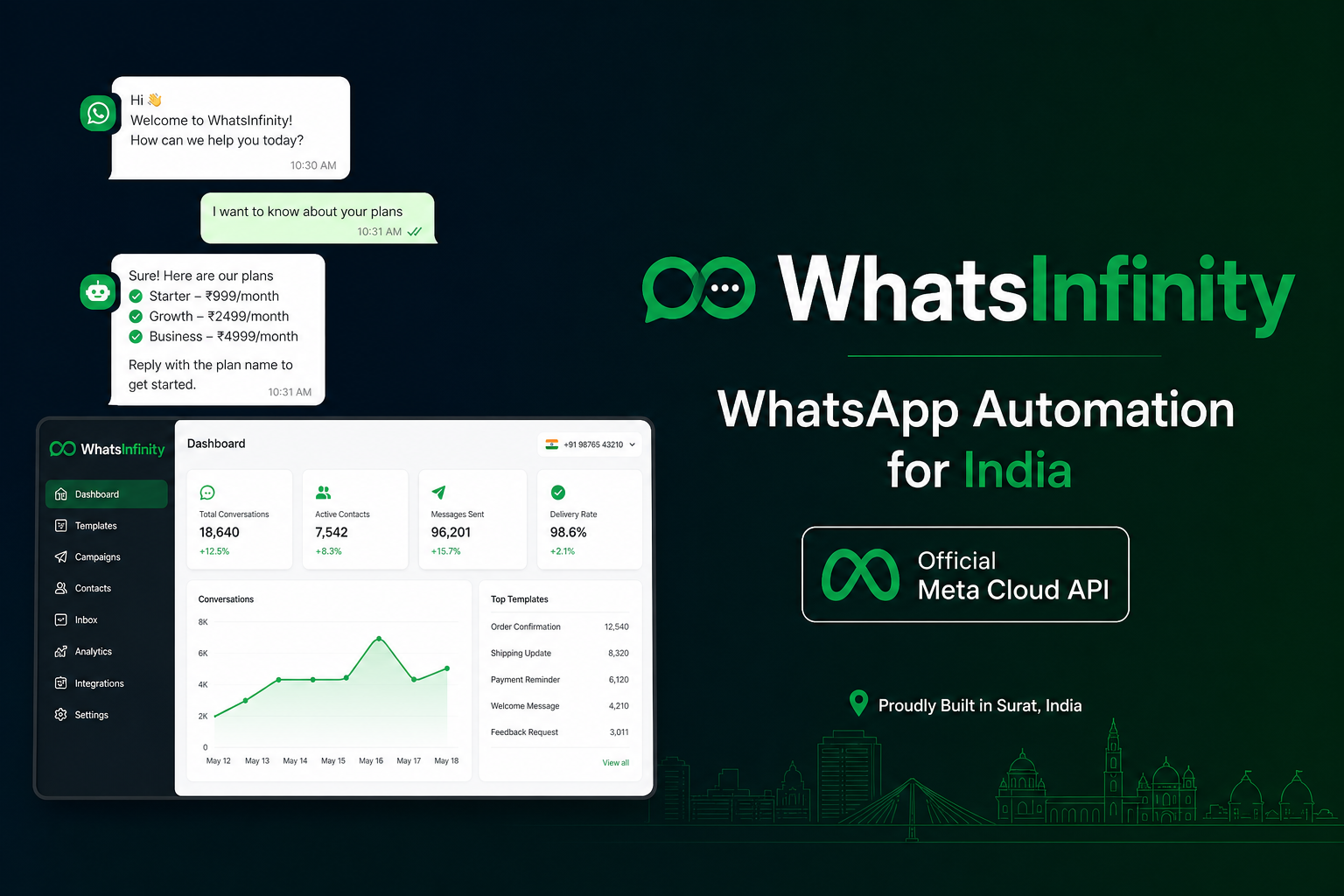
Consumers still receive a normal WhatsApp message from your verified business name. Your team triggers the send from a web dashboard — not by selecting contacts manually in the app. Tools like WhatsInfinity queue broadcast jobs in the background, rate-limit sends to protect number quality, and update sent counts as messages leave the server.
If someone promises unlimited bulk WhatsApp without templates or opt-in, they are selling risk — number bans, legal complaints, and brand damage. This guide covers the compliant path Indian SMEs, D2C brands, and agencies should follow.
Legal and policy requirements in India
Indian businesses must align with WhatsApp Business Messaging Policy and applicable telecom norms. TRAI's Do Not Disturb registry governs promotional SMS and calls; while WhatsApp is a separate channel, the principle holds: promotional outreach should go only to people who agreed to hear from you. Unsolicited template blasts to cold lists violate WhatsApp rules regardless of TRAI.
Document opt-in: timestamp, source (website, store, lead ad), and what the user agreed to receive. Maintain opt-out handling — when a customer asks to stop, deactivate them in your CRM and pause any active flows. WhatsInfinity pauses customer flows when a customer is deactivated, reducing accidental follow-ups after unsubscribe.
Marketing templates require Meta approval. Utility templates (order shipped, appointment reminder) have different categories and stricter content rules. Mis-categorizing marketing as utility to sneak promotions is a common reason templates get rejected or accounts restricted.
- Explicit opt-in before any promotional bulk send
- Approved templates only for outbound marketing outside 24-hour sessions
- No purchased, scraped, or third-party phone lists
- Honour opt-outs promptly and keep audit logs
- Avoid misleading template category selection
Templates: the unit of bulk messaging
Every bulk marketing message is a template. You compose structure in Meta Business Manager, submit for review, and after approval sync it into WhatsInfinity. Variables like {{1}} for customer name or {{2}} for order id map to system fields or custom fields per customer.
Header types matter: text headers, image headers for festival creatives, and URL buttons with dynamic suffixes for personalized links. WhatsInfinity parses template metadata — variable counts, buttons, dynamic URL flags — so your broadcast fails fast at configuration time instead of at send time with hundreds of errors.
Before a big Diwali or Republic Day campaign, refresh templates from Meta. Deleting stale copies and inserting the latest approved set prevents sending retired template names that Meta will reject mid-broadcast.
Broadcasts vs message flows
A broadcast is a one-time send to a selected audience — everyone gets the same template at roughly the same time, modulo queue rate limits. Use broadcasts for announcements: new store opening, flash sale, GST invoice reminder batch, or event invitation to an opted-in list.
Message flows are multi-step sequences over days — better for onboarding or nurture, not for single-shot festivals. WhatsInfinity runs broadcasts on a dedicated queue with spacing between messages (around 100ms) so spikes do not hammer the API. Flow messages use a separate queue with cancellable jobs if you pause a customer mid-sequence.
Choose broadcasts when timing is unified ('sale starts now'). Choose flows when spacing educates ('day 1 welcome, day 3 tips, day 7 offer'). Mixing both without coordination can annoy customers — coordinate calendars at agency level when managing multiple clients.
Building your recipient list the right way
Your bulk list lives in WhatsInfinity as customers with phone, name, tags, and custom fields. Import CSV exports from billing software, ecommerce platforms, or lead forms — but remember duplicate detection is strict: one duplicate phone fails the entire import so you fix data quality at source.
Segment with tags: 'vip', 'mumbai', 'cod-customer', 'festive-optin-2026'. Broadcast recipient selection should filter on tags and active status, not raw SQL exports from unrelated systems. Agencies isolate lists per client tenant — never merge Client A's buyers into Client B's broadcast.
Validate Indian numbers with country code 91 and no spaces or plus signs in the stored format; WhatsInfinity strips formatting on send, but consistent storage prevents duplicate entries like 9876543210 vs 919876543210.
Running a broadcast step by step
First, confirm plan limits: max customers and max messages per month apply at client level. Exceeding quota blocks new sends until the super admin records payment or upgrades the plan. Second, pick an approved template and resolve variables — empty custom fields produce failed sends or embarrassing blank slots.
Third, select recipients and launch. WhatsInfinity responds immediately while the broadcast queue processes in the background. Sent count updates periodically during large jobs. Fourth, review per-recipient status: delivered and read are success signals; failed rows include reasons when Meta returns errors.
Do not retry failed rows blindly without fixing root cause — invalid numbers, template pauses, or user blocks need different fixes. Export failure reports for client review if you are an agency.
- Pre-flight: token valid, template approved, variables mapped
- Test on 5–10 internal numbers before full blast
- Schedule around Indian business hours for B2B; evenings for D2C may work better
- Monitor read rate first hour — low reads may mean weak copy or list fatigue
- Archive campaign results for compliance and ROI discussions
Festivals, sales events, and SME use cases
Indian retail calendars drive bulk WhatsApp demand. Jewellery stores send Dhanteras offers, coaching institutes broadcast mock-test reminders, clinics send vaccination camp notices, and restaurants push weekend specials — all legitimate when opt-in exists and templates are approved.
SMEs with limited staff benefit most: one operator launches a broadcast to five thousand opted-in buyers while the shop floor handles walk-ins. Without Cloud API, the owner would manually forward messages — impossible at scale and unprofessional for brand trust.
Plan template submission early; Meta review queues lengthen before major festivals. Prepare Hindi, English, or Hinglish variants only if your audience expects them and your brand voice is consistent.
Delivery analytics and troubleshooting
WhatsInfinity logs message status: queued, sent, delivered, read, failed. Delivery rate below ninety percent on a clean list suggests credential issues, template problems, or many invalid numbers. Read rate indicates creative relevance — utility templates often read higher than pure promotion.
Common failures: expired WhatsApp access token (renew manually in settings), template disabled by Meta, variable count mismatch, or customer blocked your number. Token expiry alerts fire seven days ahead via dashboard and email so teams renew before broadcasts fail wholesale.
Agencies should compare broadcast performance across clients to spot training gaps — one client may map variables incorrectly every campaign while another achieves sixty percent read rates on similar lists.
Agency operations and multi-tenant bulk sends
Agencies manage bulk messaging for many SMB clients under WhatsInfinity's hierarchy: super admin, agency, client. Each client connects their own Meta WhatsApp Business account; the agency does not share one API number across unrelated brands unless the business model intentionally uses a parent brand.
Invite links let clients self-register under an agency with seven-day multi-use tokens. Impersonation lets agency staff configure templates and test broadcasts without sharing passwords. Audit logs record sensitive actions for accountability.
Billing is manual at client plan level — when a client's plan expires, flows stop and queues pause immediately. Agencies must renew client plans before peak season broadcasts or campaigns halt mid-queue.
What to never do
Never use unofficial WhatsApp bulk APKs — they violate Terms of Service and expose customer data. Never broadcast political or gambling content restricted by Meta. Never message users who opted in only for transactional updates with unrelated festival spam without appropriate consent scope.
Never ignore failed message spikes after a broadcast — that is often an early warning of policy review. WhatsInfinity gives you the logs; acting on them protects the business number your clients depend on for daily operations.
Frequently asked questions
- Is WhatsApp bulk messaging legal in India?
- Yes, when recipients opted in, you use approved templates through the official Cloud API, and you follow WhatsApp policy plus applicable Indian laws. Unsolicited bulk messaging is not legal or permitted by Meta.
- How many messages can I send in one broadcast?
- Limited by your client plan's monthly message quota and Meta's quality rating on your number. WhatsInfinity queues sends with rate spacing; very large lists may take time to complete.
- Can I send bulk WhatsApp without templates?
- Not for marketing outside an active 24-hour customer service window. Bulk promotional sends require approved templates. Session messages apply only when users recently messaged you.
- Why did my entire CSV import fail?
- WhatsInfinity rejects imports if any duplicate phone numbers exist in the file. Deduplicate and validate formatting, then re-import before scheduling your broadcast.